
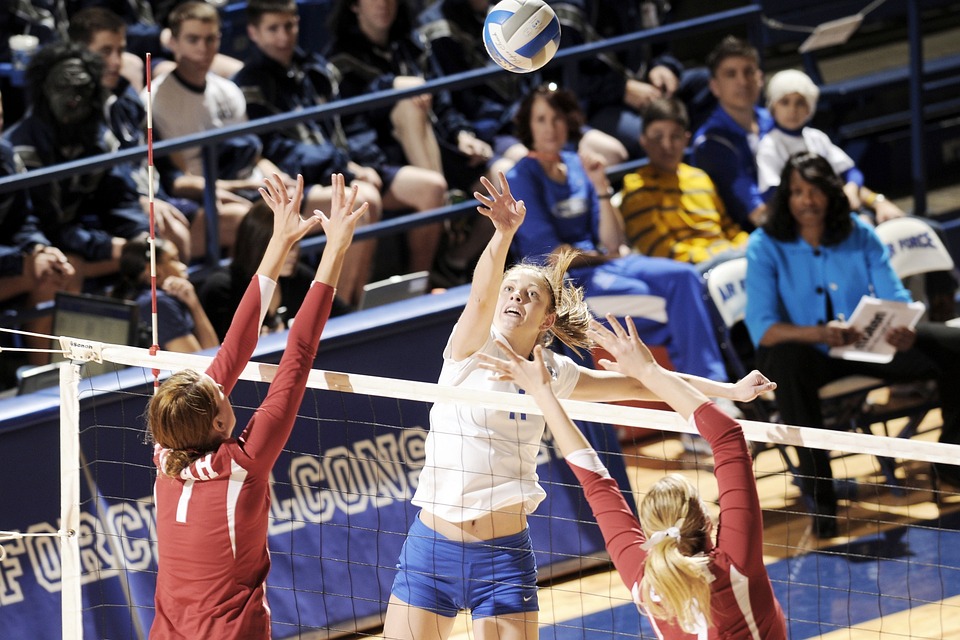
Volleyball is a sport that is loved by many and can easily be played throughout the year. However, if you have the chance to hit the field outdoors when the weather is good, why not try to get some fresh air and sunshine while playing the game you love?
There are differences between indoor and outdoor volleyball (sometimes called “sand”). These differences aren’t enough to be a real game-changer, but there are a few things you need to be aware of depending on your volleyball environment.
Volleyball court
Sand volleyball courts and indoor courts vary somewhat in size. The beach courts are actually smaller than the indoor courts. Indoor courts have a rule where players in the back row cannot advance behind a certain point in the court to hit the ball, while sand volleyball players can hit the ball from anywhere on their side of the net. The reason for the sand court’s smaller size may be that getting any traction and running in the sand is much more difficult than on a hard surface. A smaller pitch keeps the ball in play longer, making rallies more entertaining and paced.
two players for each team
With the larger court size for indoor volleyball, it is for good reason that more people are required to cover the area. Indoor volleyball requires six players per team or side. Each player has a specialized site that rotates and turns throughout the game. Sand volleyball is usually played with teams of two. One player hits from the left side of the court, while someone hits the right side. The serve is rotated between the players. There are no specialized centers and usually each player is well versed in all strikes, blocks and holes. In competition level sand volleyball players can have custom positions such as one can block and one can dig, but both can still collide.
volleyball
One of the differences between indoor and outdoor volleyball is the ball itself. The indoor balls are made of leather and are somewhat heavier than the balls used on the outside. These heavier indoor balls can take a harder hit and tend to move more quickly than the outside ball. Sand volleyballs are larger, softer, and less bulky than indoor balls. The lighter weight helps them float better in the air, allowing more experienced players to use the weather to their advantage.
Save result
Indoor volleyball has five-set matches, or matches. Matches are played until the first team reaches 25 points, and the winner of that match is declared. Three sets win the match. If both teams win in sets, a tie-break is played to 15 points. Teams switch sides after each match.
Sand volleyball has matches consisting of only three sets or matches. Games are played until the first team reaches 21 points, and if a tiebreaker game is necessary, it is played up to 15 points.
In both versions, you must win the game by a margin of at least two points.
touches
The way the ball is touched or handled by the players differs between the two types of games. Indoor volleyball allows players to block the ball without it counting as one of the three strikes allowed for each team. Sand volleyball counts one block out of the three allowed strokes.
Indoor volleyball also allows open hand tips, or dinks, which send the ball slightly over the net, but sand volleyball does not allow these types of movements.
If you enjoy volleyball, it probably doesn’t matter whether you play it indoors or outdoors. In fact, you may find that you prefer one method over the other, but just playing the game you love at any time of the year is a huge benefit. Educating yourself about both versions of the sport will help you play, and hopefully, you will enjoy the sport as well.